
Dive sites Hurghada
Overview
On our Daily dive trips we head to around 50 different dive sites in the Hurghada day area. We choose our dive sites every morning depending on the weather conditions, the wishes of our guests and, of course, the qualifications of our divers. This allows us to offer a varied programme that brings new and wonderful diving experiences every day.
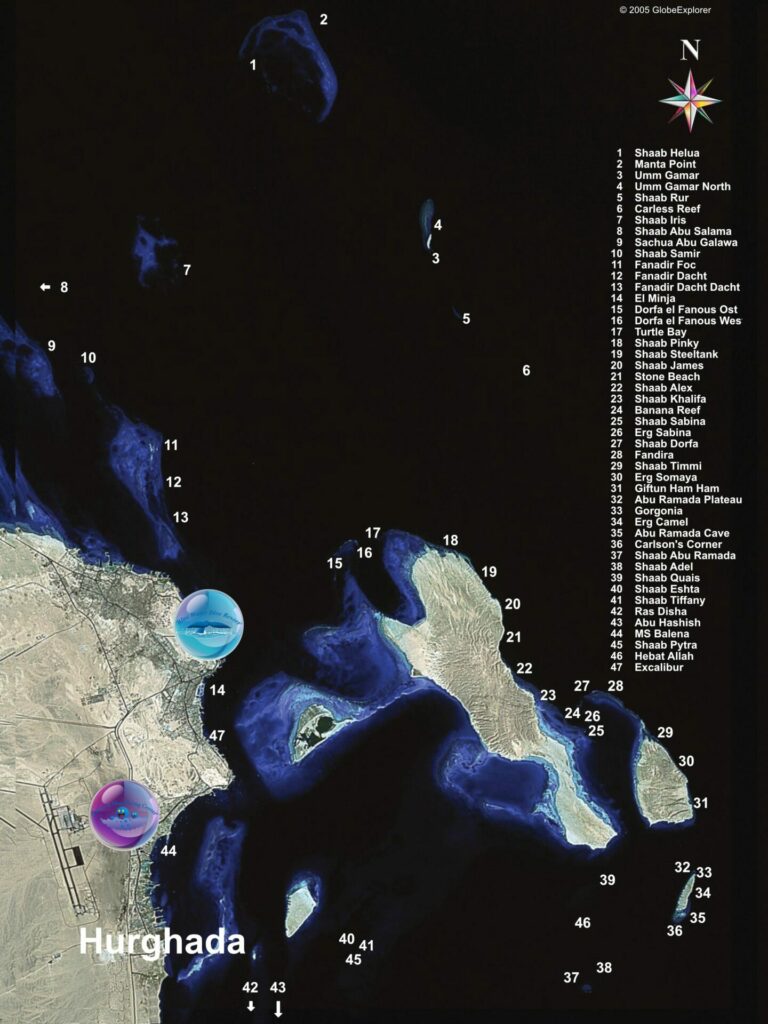
Our dive sites around Hurghada
Simply swipe across the image for more information
Shaab Helua (Arab.: „Beautiful Reef“) is the western part of the huge, horseshoe-shaped reef of Shaab El Erg.
An 8 m deep channel separates a V-shaped block from the main reef here. The boat lines are also located there.
The site is ideal for anyone who likes to gently float through a colourful coral landscape and enjoy the many colourful fish.
With a bit of luck, while diving you may also encounter the dolphins that are common there.
The dive site is located at the northern tip of Shaab El Erg and, due to the lack of mooring lines, can only be dived as a drift pick-up. Calm weather is therefore required.
An expansive coral garden awaits with shoals of garfish, snappers, monocle bream, pennant coralfish, surgeonfish, milkfish and fusiliers.
All of that can be found between 6 m and 14 m. It is not uncommon for an eagle ray or a humphead wrasse to suddenly swim through the frame. With a bit of luck, you might also encounter a turtle.
To visit the island of Umm Gamar, you travel north for about an hour.
The dive site can be dived either stationary or as a one-way dive.
The sloping reef wall on the east side and the shallower plateau to the south are very varied.
Browsers, explorers and, of course, photographers will get their money's worth here at all depths.
There is a worth-seeing cave in the steep wall at approx. 27 m.
Due to its depth, it is advisable to start the dive at the two large coral blocks on the sandy bottom. From here, head north along the reef wall.
Where the current splits, you should turn round and dive back to the boat.
Quite a few large schools of anthias, snappers and sweetlips hover effortlessly in the current, indicating the point at the northern end where the current splits.
Giant moray eels, largemouth bass and turtles are no rarity here.
About 2 kilometres south of Umm Gamar there is a „long reef“ (Arabic: rur = long) which comes up to almost the water's surface and has many crevices and overhangs.
In the southeastern part of Shaab Rur, the wreck remains of an Egyptian boat can be admired at a depth of 28 m to 35 m.
In the western area we find a broad plateau with a very large block and several smaller ones near the reef wall.
Free-swimming giant moray eels are not uncommon, but snails can also be found here.
About an hour's journey north-east of Hurghada, an open-sea reef rises from the depths like a plateau.
Two ergs stand on the plateau, the larger in the northwest, the smaller in the southeast.
Even though there are boat lines there, a pick-up is often the better option. Depending on the current, this allows you to dive along the edge towards the north or south plateau.
Along the drop-off you can find tuna, great barracuda, turtles and, with a bit of luck, hammerhead, tiger and whitetip reef sharks.
Shaab Iris is one of the dive sites around the Abu Nugar area.
The site consists of a small main reef with surrounding medium-sized bommies and is extremely rich in fish.
If we didn't already have a dive site called Aquarium, Shaab Iris would deserve the name. This shallow site is ideal for photographers, explorers and pleasure seekers. Immersing oneself in schools of fish and the sight of the soft corals is a special treat there. Eagle rays also pass by here.
Because of its shape, we also call this beautiful reef the „jelly baby reef“.
It is the Mercedes of shallow-water dive sites, as it is absolutely teeming with schooling fish. Damselfish, fusiliers and goatfish attract tuna and mackerel. Masters of camouflage, such as stonefish and scorpionfish, are also native there.
The current can be a bit more challenging here at times and split on the eastern side. In that case, the western side with its two sandy bays can be dived quite calmly.
This dive site in the north of Hurghada can be dived either as a stationary dive or as a one-way dive.
In the reef wall there are plenty of gorgeous gorgonians and soft corals. In the numerous crevices various masters of disguise as well as yellowmouth and other moray eels hide. In the open water dolphins often swim past.
Just past the mooring lines is the entrance to a narrow lagoon. There you often encounter squid, blue tang and occasionally a turtle.
This reef belongs to the Abu Galawa dive sites. It is exposed and can only be visited in good weather. Usually, stationary diving is practised here.
The coral-rich main reef can easily be circumnavigated once. Moving west from the main reef, one encounters five blocks in a row.
The main reef and the bombies are true fish magnets. With a bit of luck, you might also encounter passing dolphins.
Nearby, there is a large, old anchor attached to a block.
The „Giftun Reef“ of Hurghada consists of an elongated, 12 m high hard coral wall, a sandy plateau sloping towards the ledge and a deeply sloping drop-off with sparse growth.
In the reef wall and on the plateau, we find everything that is well camouflaged and/or venomous. Here there are reef stonefish, devil scorpionfish, red octopuses year-round, various moray eels and snake eels, rare seamoths and, with a bit of luck, frogfish.
Eagle rays, turtles and dolphins like to pass through here.
South of El Fanadir Foc (Arabic: upper) we find El Fanadir Dacht (Arabic: lower).
The dive site can optionally be dived from a fixed location, out of the lagoon, as a one-way dive, or as a drift pick-up.
On the wide sandy plateau stand several brightly coloured coral heads.
The site is ideal for photographers and fans of small stuff. Plenty of clever masters of camouflage, moray eels and all sorts of shrimp bustle about here. But nudibranchs, pipefish, cuttlefish and squid can also be found at this dive site.
South of El Fanadir Dacht lies El Fanadir „Dacht Dacht“ (Arabic: even further down). Only a pick-up dive is possible here.
During the winter months, there is a good chance of encountering eagle rays and large sand rays at this site. The most common are whiptail stingrays, mangrove stingrays and leopard whiprays. However, other encounters are also possible.
Tip: Check the visibility before the dive, as this is not always optimal!
The Egyptian minesweeper was sunk in 1970 by Israeli fighter jets.
It lies outside Hurghada harbour at a depth of 25m to 32m. Depth, visibility and the wreck itself require some diving experience.
The deck is equipped with winches and pulleys. A mine clearance device gives the impression of being fully equipped and ready for use.
There is still live ammunition on this wreck, which is why the rule not to touch anything applies especially here.
The dive site can be dived stationary or as a one-way dive.
The attractions here consist of a fine starting block and two further blocks at 12 m and 16 m, which are absolutely teeming with small anthias and fusiliers.
At the ’12er-Block‘ there also live two charming cleaner wrasse who love swimming into divers„ mouths and ears to clean them. We've named them “Itchy„ and “Scratchy".
If dolphins are present, they are often in a playful mood.
This site is also ideal for getting settled in and for diving courses.
The dive site can be dived as a one-way dive or as a stationary dive and is also ideal for diving courses.
The boat ropes are located in the large lagoon, sheltered from the wind.
Even on a one-way dive, you usually only reach a maximum depth of 15 metres. On the outside of the main reef, there are large boulders that are covered in beautiful coral and rich in fish.
Between the blocks and the main reef lies the main route of the resident sleeping dolphins, which you not infrequently encounter. Here, too, the following applies in particular – Please do not disturb!
A one-way dive is ideal, starting from the north side of the outer reef. There you will find the entrances to a unique „pool“. Here you are surrounded by great coral formations and plenty of schooling fish.
You might even come across tortoises.
The way back to the boat leads a short distance westwards along the outer reef until two arrows appear on the sandy bottom. Here, at a depth of around 3 m, you cross the reef flat into the lagoon, where the boat lines are located.
However, the site can also be dived from a fixed location.
This dive site is located on the north-eastern corner of Giftun Island Besar and can only be dived as a drift pick-up in calm weather.
At the beginning, the main reef is approx. 20 m deep and tapers towards the north to about 12 m. A gently sloping sandy plateau extends towards the open sea down to 30 m – 35 m.
Here you have a good chance of seeing big fish. But turtles and eagle rays are also native here. If the current is good, you reach a small field of garden eels at the end of the dive.
On the east side of Big Giftun Island, a little south of Shaab Pinky, there is a section of reef that we call Shaab Steeltank.
This is a reference to an empty aircraft fuel tank lying on a small plateau at 28 metres, which is often mistaken for a large torpedo.
In calm seas, a drift pick-up is possible here.
Steeply sloping overall, the reef offers good chances of seeing pelagic fish and turtles. Many overhangs serve as shelter for smaller marine life.
North of Stone Beach, on the east side of the large Giftun Island, there is a section of reef that we call ‘Shaab James‘.
In calm weather, a drift pickup dive is possible here.
From a sloping sandy area, a long and narrow plateau develops towards the south. Below the edge, there are some very nice overhangs at around 37 m.
The plateau is teeming with shoaling fish, and with a bit of luck you can see Napoleon fish, turtles and eagle rays here.
This dive site is located on the east side of Giftun Island Large and can be dived as a stationary dive or as a one-way dive to the mooring line.
Right beneath the mooring lines lies a huge cabbage coral on a gently sloping hard coral plateau. At 18 m and 14 m there are two smaller sandy areas. Towards the north leads a drop-off edge. Here, at just under 40 m, there is a remarkable overhang worth seeing.
The way back to the boat should be dived shallow in the 8 m range. Here you can find schooling fish and small creatures.
Between Stone Beach and Shaab Sabina lies a very long, largely untouched reef edge.
Only drift pick-up dives can be conducted here in calm weather.
At the main reef we find two wonderful coral gardens, one in the north, the other in the southern section. In between stand three interesting bommies on the sand plateau.
Turtles and eagle rays are not uncommon, and whale sharks also occasionally pass through here.
South of Shaab Alex (Shaab Nenad) lies a beautiful coral block at 18 m, which marks the beginning of the dive site.
Further south there are two coral gardens. Here we frequently encounter resting turtles. On the sandy plateau, particularly in the winter months, there are feathertail stingrays.
A trip to the drop-off increases the chances of spotting eagle rays and other larger marine life.
This dive is only possible as a drift pick-up dive, as there are no boat lines here.
Between the islands at the northern exit of the channel lies Banana Reef. Here you can choose between stationary or one-way diving.
North of the main reef, at about 14 m, stand two boulders, a larger and a smaller one.
Parallel to the main reef runs a sandy track, and behind it lies a coral garden.
To the west stands a large block where bigeye scad frequently hunt.
With a bit of luck, you can also encounter eagle rays or turtles here.
Due to its location in the channel, Shaab Sabina is well protected and can be visited in almost any weather.
This offers a one-way dive back to the boat, but stationary diving from within the lagoon is also possible.
The jump point is located above the northern coral garden. Hard corals and abundant shoaling fish dominate here. Another coral garden, running parallel to the main reef, offers a fascinating landscape of hills.
At this site, eagle rays and also turtles are frequently encountered.
In the middle of the channel between Greater and Lesser Giftun Island lies Erg Sabina.
Here, there is a small but exquisite main reef with an exceptionally well-covered west side. That will make not only photographers' hearts beat faster!
To the north, about 40 m from the main reef, stands a gorgeous coral block. Here you have a good chance of seeing eagle rays and turtles, especially in the morning.
Many beautiful coral formations invite you to take your time and inspect them.
Next to Banana Reef we find Shaab Dorfa. Here, people like to do a one-way dive into the lagoon back to the boat.
To the north, the double blocks stand at about 20 m. There you frequently encounter eagle rays and a green sea turtle. Not far in a south-easterly direction lies another large block at 16 m, followed by a block at 14 m within visible distance.
Navigation skills are an advantage here. It is easy to misjudge your dive and end up heading towards Banana Reef.
In front of the protected lagoon lies another fish-rich bommie at 12 m.
North of the small Giftun Island, an arc-shaped reef stretches along, ending in a westerly direction at Shaab Dorfa.
This dive site can only be explored as a drift pick-up dive when the sea is calm. In the winter months, we find sleeping white-tip reef sharks in their caves there.
At the edge at 25 m we frequently encounter surgeonfish, fusiliers, trevallies, yellowfin tunas and eagle rays.
Turtles like to sleep on the plateau, and in winter you can encounter mangrove stingrays.
On the east side of the small Giftun Island lies Shaab Timmi in a northerly direction.
Calm weather is a prerequisite here, as only a drift pick-up dive is possible.
On a gorgeously overgrown, lower-lying plateau, there are many gorgonians and black corals. In the reef wall, a long fire hose stands out.
A look into the blue water could be worthwhile. With a bit of luck, encounters with sharks are also possible. Both whale sharks and hammerheads have already been sighted here.
On the eastern side of Giftun Small Island, we find this famous dive site. There are two boat moorings here, but we usually prefer a drift dive.
At the edge there are two brilliantly overgrown boulders. One boulder is split and can easily be swum through between 27 m and 30 m.
Continuing along the right-hand reef, we pass the wonderful „Erg Somaya“ block, which gave the dive site its name.
The rest of the dive is best spent directly at the main reef, enjoying the abundance of fish and the scenery.
On the small Giftun Island, there is a police station and a small toilet block (Arabic: Ham Ham) in the south. That is how this spot got its name.
Giftun Ham Ham is a classic in Hurghada and is dived as a drift dive. There is a beautiful gorgonian forest on the drop-off. Longnose hawkfish are at home here.
On the plateau you encounter humphead wrasses and, with a bit of luck, bumphead parrotfish.
At the end of the dive, on the Giftun Soraya Plateau, which can also be dived as a stationary dive, are the boat mooring lines.
At the northern tip of the island of Abu Ramada lies the elongated plateau. It begins at the reef wall at 10 m and slopes down gently to over 30 m. Most of the time there is a strong current here, perfect for an exciting dive. This site is therefore generally unsuitable for beginners. In the vast majority of cases, the dive is a drift pick-up.
The plateau is teeming with fish. Snappers, surgeonfish, fusiliers, mackerel, barracuda and whitetip reef sharks feel right at home there.
Even mobula rays and whale sharks have already been sighted along the plateau.
On the east side of Abu Ramada island, immediately south of the plateau, we find a beautiful, brightly coloured steep wall.
Due to the numerous large gorgonian fans, this section is called Gorgonia. But black corals and bushy soft corals are also present here in abundance.
Here you can encounter countless schooling fish, turtles, longnose hawkfish, giant moray eels and tuna.
Sometimes there is a stronger current here.
Although a stationary dive is possible, due to the frequent currents we prefer a drift dive towards Abu Ramada Cave.
There are soft corals and schooling fish in abundance here. That inevitably attracts mackerel and tuna.
But tortoises can also be found here regularly.
A little further south is a patch of sand with garden eels.
During the winter months, you have a good chance of seeing whitetip reef sharks here.
We can find this dive site on the south-east side of the island of Abu Ramada. Here you will find the so-called „pizza oven“, a large block (20 m – 31 m) next to the main reef.
On its north side there is a large opening at 24 m. Here you can easily look inside the block.
Glassfish, broadband pipefish, Bruun's cleaner shrimp and various groupers are native here.
Occasionally one also encounters eagle rays, turtles or bumphead parrotfish.
On the south side of Abu Ramada Island lies this spot, also known as ‚Carlson's Corner‘.
You can dive here in almost all wind conditions. The site is very well suited for stationary dives and also diving courses. If you want to drift, you can jump in on the west side and let yourself drift to the boat lines on the south side.
The remains of a small wreck are usually explored here at the end of the dive. A Napoleon wrasse is resident at this site.
Also known as the „Aquarium“. Can be dived either as a stationary dive or a one-way dive. On the east side there is a beautiful coral garden with many schooling fish and masters of disguise.
On the west side there are two large coral blocks that can be circled in a figure of eight.
In August, you shouldn't get too close to the aggressive yellow-margined triggerfish here.
There is something to discover everywhere, so long dives of over 70 minutes are not uncommon.
West of Shaab Abu Ramada (Aquarium), right in the middle of the sea, lies Sha‘ab Adel.
In calm weather, a pick-up dive is possible here.
Einen echten Tauch-Plan gibt es nicht, so kann man sich gut nach der Strömung ausrichten. Viele Blöcke befinden sich in einer Maximaltiefe von bis zu ca. 18 m.
Der bekannteste Bewohner ist ein Leopardenhai. Meist liegt er irgendwo auf dem Plateau und schläft. Aber auch die Rotmeer-Sternschnecke ist ein beliebtes Fotomotiv.
Shaab Quais Maksur liegt auf einem großen, ca. 12 m tiefen Sandplateau südlich der großen Giftun Insel. Maksur heißt im Arabischen „gebrochen“ und ist eine Anspielung auf den zentralen großen Block mit seinem betauchbaren Durchgang.
Die schön bewachsenen Blöcke mit teils eigenwilligen Formen regen die Fantasie an. So findet man z. B. einen großen Pferdekopf oder den Schiefen Turm von Pisa.
Mit ganz viel Glück trifft man einen Leopardenhai oder auch Delfine. Ein guter Orientierungssinn kann hier nützlich sein.
Zwei große Blöcke und einige Ausleger, etwa fünf Tauchminuten voneinander entfernt, bilden einen kleinen, aber wunderschönen und sehr fischreichen Tauchplatz.
Die Magawish Insel bietet zwar etwas Schutz, jedoch sollte es idealerweise nicht zu wellig sein.
An den Blöcken und auf dem Sandboden wuselt es von Fischschwärmen. Sandbewohner und Tarnkünstler verstecken sich.
Besonders häufig trifft man hier auf juvenile Fische, die an diesem Platz eine geschützte Kinderstube vorfinden.
Dieses kleine, aber feine Riff gehört zu den Tauchplätzen rund um die Magawish Insel.
Hier wird üblicherweise stationär getaucht. Zwei größere Blöcke, eine Seegraswiese und mehrere kleinere Blöcke in Sichtweite bilden eine Einheit.
Im Süden befinden sich die Bootsleinen. Der Platz ist ideal für Fotografen, Entdecker und Fans von Makroaufnahmen.
Oktopus, Kalmare und Garnelen aller Art laden zum Bestaunen ein.
In der Seegraswiese tarnen sich Seegras-Geisterpfeifenfische und Nadelpferdchen.
Wie auch Shaab Eshta und Shaab Tiffany befindet sich Shaab Pytra ebenfalls auf dem Magawish Plateau.
Sein anderer Name ist Shaab Talata, Dieser Name rührt von der Form des kleinen Riffs, das der arabisch geschriebenen Zahl 3 ähnelt.
Shaab Pytra ist ein schöner, flacher und bunter Tauchplatz, der für jeden etwas zu bieten hat. Fotografen kommen hier voll auf ihr Kosten, aber auch taucherisch noch nicht sehr erfahrene Unterwasserliebhaber fühlen sich hier wohl.
In der Regel werden die Tauchgänge hier stationär durchgeführt. Das Riff eignet sich auch für Nachttauchgänge.
Ras Disha lässt sich stationär, als One Way oder als Drift Pick Up Dive betauchen.
Neben dem Hauptriff verläuft parallel ein Plateau mit einer Drop Off Kante. Das Plateau wird nach Süden hin immer breiter und bietet immer mehr Blöcke, die sehr fischreich sind.
Auf dem Hauptplateau stehen mehrere schön bewachsene Ergs.
Man trifft häufiger Adlerrochen, Schildkröten, Krokodilfische und Barrakudas an.
Auf dem sandigen Abhang zwischen 20 m und 27 m ist ein Feld mit Röhrenaalen.
Die Insel bildet im südlichen Teil ein lang gezogenes Riffdach, das bis zur Wasseroberfläche reicht. Im nördlichen Teil finden wir eine schön bewachsene Riffwand, ein schmales abfallendes Plateau und eine Drop Off Kante mit Überhängen und kleinen Höhlen.
Im südlichen Bereich wird das Plateau deutlich breiter. Gerne verstecken sich hier Muränen, Rote Kraken, Schildkröten und Drachenköpfe. An der Kante trifft man gelegentlich Adlerrochen und Napoleons.
Dieser Platz kann sowohl stationär als auch als One Way oder Pick Up Dive betaucht werden.
Das „Hausriff“ von James & Mac wurde 1952 in Norwegen gebaut und war viele Jahre als Post- und Versorgungs-Schiff unterwegs. Wegen Schmuggels wurde es 1987 beschlagnahmt und schließlich umgebaut und verkauft.
1992 wurde das Schiff in Hurghada stationiert und war als Safarischiff im Einsatz.
Seit 12.04.2001 liegt die Balena nun bei ca. 9 m auf dem Grund. Das Schiff ist 40 m lang und 7 m breit.
Wegen seines Fischreichtums und der vielen juvenilen Meeresbewohner, ist das Wrack heute ein beliebtes Ausflugsziel. Fotografen und Entdecker kommen hier, trotz manchmal geringer Sichtweiten, voll auf ihre Kosten.
Die Excalibur war ein zweimastiges Motor- und Segelschiff von etwa 22 Metern Länge. Sie sank 1995, und die Gründe für den Untergang sind bis heute nicht komplett geklärt. Vermutet wird ein Feuer im Hauptteil des Decks, das zum Untergang führte.
Das Wrack liegt aufrecht auf einem sandigen Grund in 22 Metern Wassertiefe mit leichter Steuerbordseite. Man kann in das Wrack hineintauchen und das Steuerhaus und einige der Unterkunftsräume anschauen. Die Excalibur wurde u. a. von Glasfischen, Rotfeuerfischen und Barrakudas besiedelt.
Das Wrack befindet sich in der Nähe des Ufers, ist in einem guten Zustand und seine Erkundung ist sehr einfach. Eine Tauchlampe lohnt sich.
Die Hebat Allah ist ein Frachter mit knapp 500 BRT. Das 44,5 m lange und 8,5 m breite Schiff mit Dieselmotoren wurde 1985 in Frankreich gebaut.
Sie sollte das erste künstliche Riff bei Hurghada werden. Sämtliches Öl, Diesel, lose Gegenstände und Müll wurden entfernt und einige Bereiche gesperrt.
Im November 2004 wurde die Hebat Allah zwischen Shaab Abu Ramada und Shaab Quais versenkt. Leider hat man es an der falschen Stelle versenkt und es landete stattdessen aufrecht in 46 Metern Wassertiefe im Sand. Die beiden Aufbauten reichen bis zu einer Tiefe von ca. 25 und 15 Metern.
Um das Wrack herum tummeln sich etliche Fischschwärme.
Das Hausriff der Tauchbasis Blue Water Dive Resort liegt direkt am Strand des Arabella Hotels. Tauchgänge sind an der Basis buchbar und erfolgen in der Regel ohne Tauchlehrerbegleitung. Diese ist auf Wunsch möglich.
Man kann das Hausriff bequem über eine Leiter erreichen. Mit seinen verschiedenen Tiefen von Stehtiefe bis 40 m ist es sowohl für Anfänger als auch für Fortgeschrittene geeignet. Es gibt hier keine Strömung. Auch für Tauchkurse ist es bestens geeignet.
Verschiedene schön bewachsene Blöcke in unterschiedlichen Tiefen und ein großer Fischreichtum erfreuen das Taucherherz und laden zu mehreren Tauchgängen ein.